
In the chemical fiber industry, filter packs and spinnerets gradually become clogged with polymer residues during production and thus require regular cleaning. Traditional incineration or chemical solvent methods, however, face serious bottlenecks: excessive exhaust emissions, high waste‑liquid disposal costs, and significant wear on the workpieces. As national environmental regulations grow increasingly stringent, the Vacuum Pyrolysis Furnace (also called a vacuum cleaning furnace) – with its closed‑loop thermal cracking process and controllable emission treatment system – is rapidly becoming the standard equipment for component cleaning in fiber manufacturing plants. This article focuses on the environmental emission control pathways of the Vacuum Pyrolysis Furnace and explains how to achieve a clean, fully compliant component cleaning process.
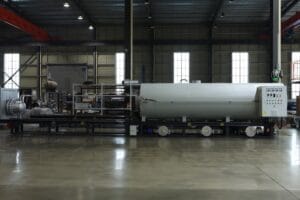
The Environmental Challenges of Traditional Cleaning Methods
In chemical fiber production, spinnerets, filter packs, and metering pumps accumulate polymer residues and require regular cleaning. Traditional approaches, however, create serious environmental bottlenecks.
- Direct incineration releases fugitive emissions and often exceeds particulate and VOC limits.
- Salt-bath furnaces generate molten salt waste that must be disposed of as hazardous material.
- Chemical solvents produce large volumes of organic waste liquid, raising both disposal costs and occupational health risks.
These methods struggle to meet tightening regulations. By contrast, the vacuum pyrolysis furnace operates as a closed-system thermal cracking unit, which allows centralized exhaust purification and eliminates hazardous waste streams.
How a Vacuum Pyrolysis Furnace Controls Emissions at the Source
Vacuum Pyrolysis: Cracking Polymers in an Oxygen-Free Environment
The core technology of the vacuum pyrolysis furnace (also called a vacuum cleaning furnace) relies on thermal decomposition under controlled negative pressure. When the chamber temperature reaches 350–400°C and the vacuum level stays between -0.05 and -0.09 MPa, polymer macromolecules (from PET, nylon, polypropylene, etc.) break down into small gaseous hydrocarbons.
This process offers three key emission-control advantages:
- The oxygen‑free atmosphere prevents nitrogen oxide (NOx) formation during heating.
- The fully sealed system contains all pyrolysis gases, so no fugitive emissions escape.
- Precise temperature control (±1°C) keeps cracking within the optimal range and avoids secondary reactions that produce tar or char.
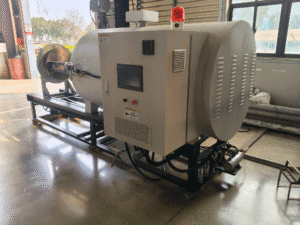
vacuum cleaning furnace
Integrated Exhaust Treatment: Ensuring End‑of‑Pipe Compliance
The off‑gas from the vacuum pyrolysis furnace passes through a multi‑stage purification train before discharge.
1. Condensation recovery – The hot gas stream cools in a condenser, where high‑boiling components liquefy into recoverable oil (usable as fuel or recycled).
2. Catalytic or thermal combustion – Non‑condensable gases enter a catalytic oxidizer or afterburner. Thermal oxidation operates at ≥760°C, while catalytic combustion lowers the temperature to 300–400°C, reducing energy consumption. Both routes thoroughly oxidize hydrocarbons to CO₂ and H₂O.
3. Adsorption polishing – A final activated‑carbon bed removes any remaining VOCs and particulates, ensuring the exhaust meets national standards such as GB 16297‑1996 (Integrated Emission Standard of Air Pollutants) and regional limits like Zhejiang DB33/2046‑2019.
Our vacuum pyrolysis furnace series includes these treatment modules as standard, and we offer custom configurations to match local regulatory requirements.
Minimal Solid Residue and Simple Disposal
Unlike solvent‑based cleaning, which generates hazardous liquid waste, the vacuum pyrolysis furnace leaves only a thin inorganic ash layer on the workpiece – about 1–3% of the original polymer weight. A simple compressed‑air blow‑off removes this ash. The process produces no waste liquid, so solid disposal costs remain significantly lower than those of alternative methods.
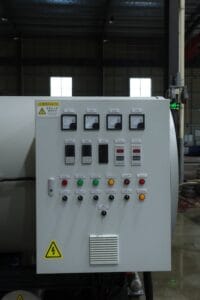
Proven Compliance in Leading Chemical Fiber Enterprises
Major domestic players have already switched to the vacuum pyrolysis furnace for component cleaning. Our equipment serves:
- Integrated petrochemical groups: Hengli Group, Shenghong Group, Sinopec subsidiaries
- Emerging sectors: Cybrid (photovoltaic backsheet materials), BYD
These facilities operate in highly regulated industrial parks – many in Zhejiang and Jiangsu provinces have implemented LDAR (Leak Detection and Repair) programs and continuous VOC monitoring. The reliable, long‑term operation of our vacuum pyrolysis furnace at these sites confirms that its emission performance satisfies the most rigorous compliance audits.
Selection and Operation Best Practices
To maximize both cleaning efficiency and environmental performance, consider these factors when choosing a vacuum pyrolysis furnace:
- Capacity matching – Select the chamber volume based on your daily component throughput. We offer sizes from laboratory‑scale units to large industrial models that handle full spinneret batches.
- Temperature precision – Ensure the control system maintains ±1°C stability to prevent overheating, which can deform parts or cause excessive carbonization.
- Tail‑gas treatment choice – Decide between catalytic combustion and thermal oxidation based on local emission limits and your plant’s utility availability.
- Explosion protection – For hazardous areas, confirm that the furnace meets the required rating (we provide Exd IIB T4 explosion‑proof options).
- Operator training – Choose a supplier that offers comprehensive training on vacuum control, heating ramp profiles, and maintenance of the off‑gas system.
Conclusion
The vacuum pyrolysis furnace offers a closed‑loop, thermally efficient solution for cleaning chemical fiber components while meeting stringent environmental standards. Its integrated vacuum cracking and exhaust purification technology eliminates hazardous waste, reduces VOC and NOx emissions, and helps fiber producers avoid compliance risks. As regulations continue to tighten, this equipment has become an essential asset for sustainable production.
For detailed emission test reports, technical data sheets, or to arrange a site visit to our reference installations, please contact us. You can also explore our full product lineup and case studies on our official website or refer to the official Chinese emission standard GB 16297‑1996 for regulatory context.