
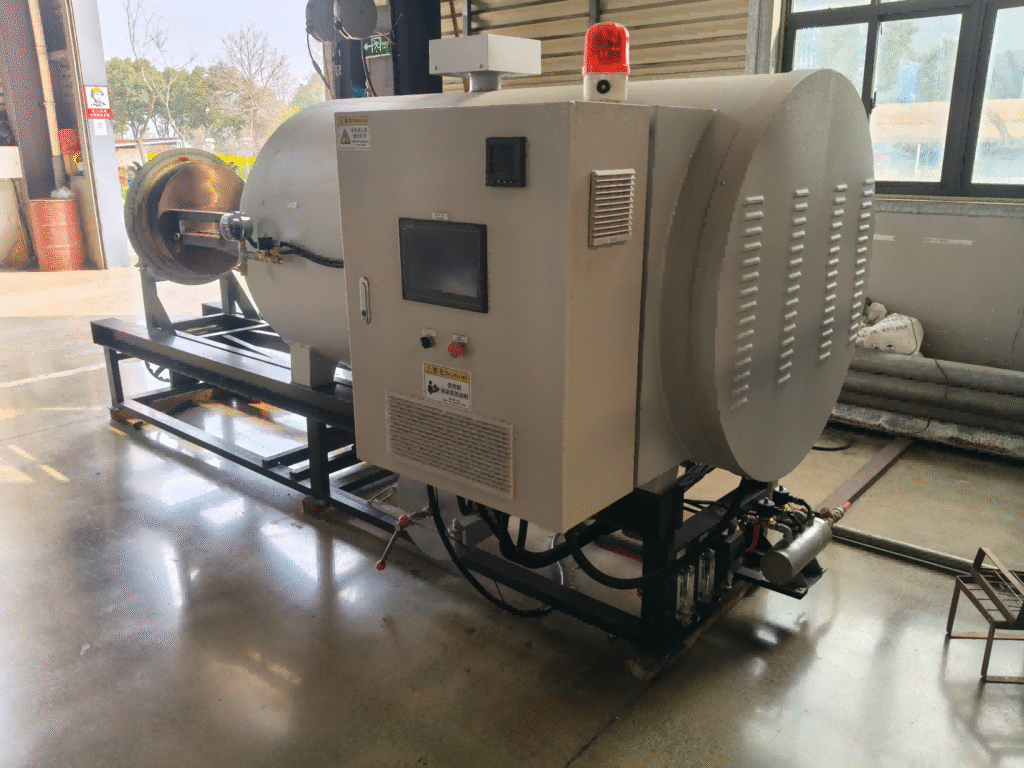
Red-Hot Conditions at the Discharge Port of Vacuum Cleaning Furnaces pose serious safety risks. This article analyzes why this happens, provides a five-step emergency response, and outlines preventive maintenance to keep your equipment safe.
I. Why Does the Discharge Port of a Vacuum Cleaning Furnace Become Red-Hot?
Accumulation of Residuals and Secondary Combustion (the most direct cause):
After a single cleaning cycle, cracking byproducts may not fully or smoothly exit the system. They accumulate in the discharge channel or valve port. During subsequent heating cycles, these residuals can undergo incomplete secondary combustion or sustained high-temperature decomposition, generating significant extra heat. Because the material stays in a fixed position, this heat continuously acts on localized metal parts.
Seal Failure and Air Infiltration:
The core advantage of a vacuum cleaning furnace lies in performing high-temperature polymer cracking in an oxygen-deficient or oxygen-free environment. If the discharge valve or related flanges lose sealing integrity, outside air may enter. Trace oxygen combines with hot residual carbon, triggering an intense oxidation reaction (similar to “burning charcoal”). This reaction releases a large amount of heat in a short time, rapidly raising the temperature of metal components and turning them red-hot.
Inadequate Cooling System Performance:
Some discharge ports include cooling jackets. If cooling water lines clog, flow rates drop, or cooling medium temperatures rise too high, heat dissipation capacity decreases. The system then cannot offset normal process heat conducted to the port.
Instrument Malfunction and Temperature Control Errors:
If a thermocouple responsible for monitoring this area (or a related heating zone) fails, or if the control system drifts, actual heating power may become too high or heating may last too long. Excess heat then transfers to the discharge port.
II. Immediate Actions When the Discharge Port Glows Red-Hot
Step 1: Stop the system safely – immediately.
Cut off main heating power and halt the current cleaning program. This provides the fundamental measure to stop further heat input.
Step 2: Keep the vacuum system running.
Do not break vacuum or open the furnace door. Maintaining the vacuum environment continues to block oxygen, preventing air from entering and causing more violent combustion or explosion risks. At the same time, start or keep the furnace’s own cooling procedure (if available).
Step 3: Apply external assisted cooling.
After ensuring electrical safety (equipment disconnected and cooling media non‑conductive), use plant compressed air (dry and oil‑free) to blow the red‑hot area. This promotes convective heat dissipation. Never spray cold water directly – extreme thermal stress can crack hot metal and create a serious hazard.
Step 4: Monitor closely and record observations.
Watch for color changes in the red‑hot area. Record the time from discovery until the temperature clearly drops. Only after the equipment fully cools to room temperature should you proceed with further inspection.
Step 5: Conduct a thorough inspection and lock in the root cause.
After cooling, systematically check:
Does the discharge valve open and close freely? Is there severe coking or blockage inside?
Are all seals and flange faces intact?
Is the cooling water path unobstructed?
Do the relevant temperature sensors read accurately?
III. Building a Preventive Maintenance System to Avoid Future Red-Hot Conditions
While solving emergency problems is critical, establishing preventive mechanisms ensures long‑term reliable operation. Integrate the following points into your regular maintenance schedule.
Standardize Operation and Cleaning Procedures:
After each cleaning cycle, confirm complete discharge of byproducts. Add a brief “cleaning sweep” step when needed, or manually inspect and clean the discharge path periodically (e.g., every 20–30 cycles) to prevent gradual buildup.
Perform Regular Seal System Inspections:
Include dynamic and static sealing points (discharge valve, viewports, flanges) on a monthly checklist. Check seals for aging and wear, and replace them in time. A vacuum hold test effectively verifies overall sealing integrity.
Verify Cooling System Effectiveness:
Regularly check cooling water pressure, flow rate, and outlet temperature. Clean strainers or filters to ensure efficient heat dissipation.
Calibrate Instruments and the Control System:
Follow the equipment manual’s requirements to periodically calibrate key temperature sensors, vacuum gauges, and the PLC control module. This maintains precise process execution.
Provide Specialized Operator Training:
Make sure every operator understands why a discharge port can turn red‑hot and the dangers involved. Train them in the standard emergency response procedure so they can detect, report, and address issues early.
By following this guide, you can effectively manage and prevent Red-Hot Conditions at the Discharge Port of Vacuum Cleaning Furnaces.