
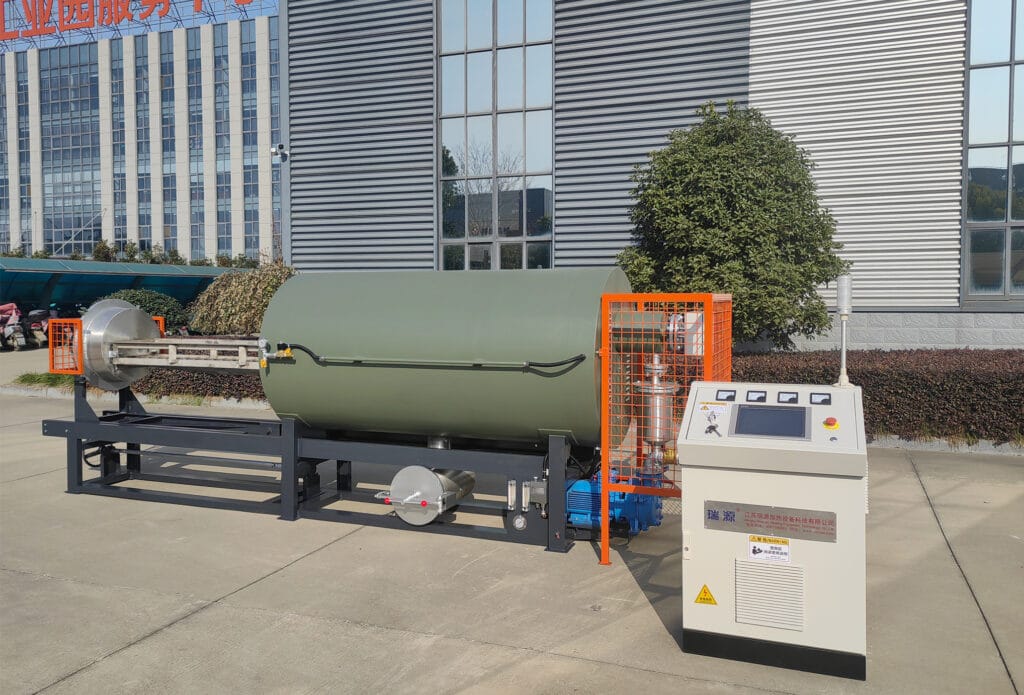
In industrial sectors such as chemical fibers and polymer materials, the industrial Vacuum Cleaning Furnace has gained widespread adoption. It serves as an efficient and environmentally friendly cleaning solution. However, a critical question often confuses equipment users, purchasers, and even manufacturers. Does a Vacuum Cleaning Furnace qualify as special equipment? The answer determines compliance in procurement, installation, and operation. It also directly impacts production safety and legal liabilities. Today, we will clarify this key concept from regulatory, standard, and professional perspectives.
What Defines Special Equipment for a industrial Vacuum Cleaning Furnace?
To classify a industrial Vacuum Cleaning Furnace , we must first establish the legal definition of “special equipment.” China’s current Special Equipment Safety Law and related technical regulations provide clear criteria. Special equipment refers to boilers, pressure vessels (including gas cylinders), pressure pipes, elevators, cranes, cableways, large amusement rides, and industrial vehicles. These items involve significant safety risks and pose substantial danger to human life.
The definition hinges on two critical attributes: “life safety” and “high risk.” Specific thresholds further refine the classification. These include working pressure, volume, medium type, and temperature. For example, boilers and pressure vessels must meet clear pressure and volume criteria. Once equipment falls under the special equipment catalog, every stage of its lifecycle faces strict supervision. This includes design, manufacturing, installation, operation, inspection, repair, and modification. National special equipment safety authorities enforce these rules.
Technical Positioning of the industrial Vacuum Cleaning Furnace
Based on industry literature and manufacturer product descriptions, a typical industrial Vacuum Cleaning Furnace has a specific operating principle. It creates a vacuum or low-pressure environment inside a sealed chamber. Electric heating then causes deposited polymers to undergo thermal cracking or volatilization. This occurs under oxygen-free or low-oxygen conditions, achieving effective cleaning.
From a technical parameters standpoint, the core working chamber (the furnace body) does not continuously hold high pressure during operation. Specifically, it rarely maintains a gauge pressure of 0.1 MPa or higher with gases, liquefied gases, or low-boiling-point liquids. Instead, the design focuses on precise temperature control, vacuum generation and retention, and exhaust gas treatment. The equipment does not prioritize withstanding high internal pressure. This fundamental difference distinguishes it from conventional “pressure vessels” in both design and function.
Regulatory Basis for industrial Vacuum Cleaning Furnace Classification
To determine whether a Vacuum Cleaning Furnace qualifies as a pressure vessel under special equipment regulations, we must reference two authoritative documents. These are the Special Equipment Catalog and TSG 21-2016 Supervision Regulation for Stationary Pressure Vessels.
The regulation clearly defines the conditions for pressure vessel classification. A container qualifies only if it meets all the following conditions simultaneously:
- Operating pressure equal to or greater than 0.1 MPa (gauge pressure)
- Volume equal to or greater than 30 liters and internal diameter equal to or greater than 150 mm
- The medium is a gas, liquefied gas, or a liquid with a maximum operating temperature equal to or higher than its boiling point at standard pressure
Therefore, most industrial Vacuum Cleaning Furnace units in the chemical fiber industry operate below 0.1 MPa. Their furnace pressure often remains in a negative pressure state. As long as the design parameters do not simultaneously satisfy all three conditions, authorities do not classify it as a pressure vessel. The key determinant lies in the nameplate parameters and design documentation provided by the manufacturer.
Higher Safety Requirements for industrial Vacuum Cleaning Furnaces
Although most standard-model industrial Vacuum Cleaning Furnace units may not fall under direct special equipment supervision, this in no way lowers their safety requirements. In fact, the opposite holds true. These systems involve high temperatures, electric heating, vacuum environments, and potentially combustible volatile gases. Their safe operation is absolutely critical.
Responsible professional manufacturers follow rigorous safety standards. Take Ruiyuan Heating Equipment Technology as an example. With over 30 years of experience, the company designs and produces equipment in strict compliance with multiple safety standards. These standards include but are not limited to the following:
- Multiple safety protection systems: These include over-temperature protection, thermocouple break protection, pressure safety interlocks, and reliable vacuum sealing with leak detection.
- High-standard electrical safety: Explosion-proof electrical components (e.g., ExdⅡCT4 rating) and high ingress protection (e.g., IP66) ensure safety in potentially hazardous environments.
- Compliance with general machinery and electrical safety standards: The equipment must meet national standards for industrial electrothermal equipment and machinery safety.
- Comprehensive process quality system: Reputable manufacturers maintain sound quality management systems. This ensures reliability and control at every stage, from design and materials to manufacturing and testing.
Professional Recommendations for industrial Vacuum Cleaning Furnace Users
For companies planning to purchase or currently operating a industrial Vacuum Cleaning Furnace, we recommend the following steps. These will ensure full compliance and safety.
1. Verify design parameters. Request a detailed technical specification sheet from the equipment manufacturer. Focus on the furnace’s maximum allowable operating pressure (gauge pressure), volume, operating temperature, and medium. This forms the primary legal basis for classification.
2. Review manufacturer qualifications. Prioritize established manufacturers with comprehensive certifications. Look for a Class B boiler manufacturing license and a Class D pressure vessel manufacturing license. Even if the vacuum furnace is not a pressure vessel, these credentials demonstrate deep experience. They also show control over high-pressure, high-temperature equipment safety systems. Also verify CCC certification and explosion-proof certification. Their technical foundation and quality system provide the cornerstone for long-term safe operation.
3. Clarify equipment classification during procurement. In the purchase contract or technical agreement, request written confirmation from the manufacturer. Ask whether the equipment falls under the Special Equipment Catalog. This clearly defines both parties’ responsibilities for subsequent registration and inspection processes.
4. Follow installation and operation guidelines. Even if the equipment is not classified as special equipment, strictly adhere to the manufacturer’s installation instructions. Follow the safety operating procedures. Provide professional training to all operators. Regular maintenance remains indispensable.
5. Monitor local regulatory developments. Different regional special equipment safety supervision departments may have nuanced interpretations. Some cases involve specific processes or equipment configurations. When in doubt, consult local authorities proactively.
Conclusion
For the majority of industrial Vacuum Cleaning Furnace units used in the polymer industry, the typical operating pressure parameters tell a clear story. These units do not legally qualify as special equipment (pressure vessels). However, not being classified as special equipment does not equate to having no safety requirements. In industrial safety, compliance is merely the baseline. Pursuing a higher level of safety redundancy through excellent design and rigorous manufacturing reflects a true commitment. This commitment extends to the enterprise, its employees, and society. By partnering with technically capable, well-qualified manufacturers, companies can truly master advanced cleaning equipment. They can safeguard clean production and ensure that both efficiency and safety go hand in hand.