
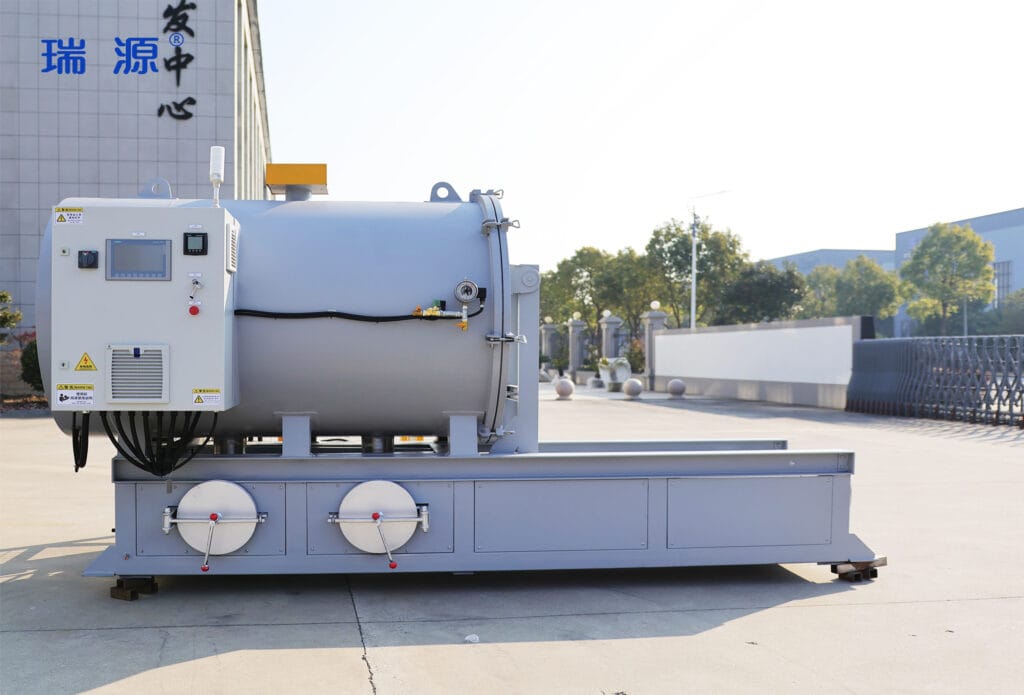
In industries like chemical fiber, plastic extrusion, and precision manufacturing, keeping core components clean is vital. Parts such as spinnerets, filter cores, and extrusion dies directly impact product quality and equipment lifespan. Traditional methods like manual scrubbing or glycol baths often damage parts, prove inefficient, or harm the environment. Consequently, the vacuum cleaning furnace (also known as a vacuum pyrolysis furnace) has become an industry standard. It leverages the thermal pyrolysis of polymers to offer a clean, efficient, and automated cleaning process.
Core Working Principle: Stage-by-Stage Pyrolysis
How does a vacuum cleaning furnace work? It relies on the physical and chemical changes of polymers under specific temperatures and oxygen levels. The cleaning process typically involves two key stages:
- High-Temperature Melting Stage: First, the furnace heats the parts to around 300°C and holds that temperature. Here, the bulk of polymer residue (like polyester, nylon, or polypropylene melts) absorbs heat and melts. Gravity then pulls this molten material down into a waste collection container at the furnace bottom. This achieves the initial gross removal.
- Vacuum Oxidation Pyrolysis Stage: Next, the temperature rises further, reaching 400-500°C. At this point, the system activates a vacuum pump and introduces a small, controlled amount of air. This triggers deep oxidation, breaking down any remaining residue into harmless carbon dioxide and water vapor. Finally, a water spray washing system cools and cleans these gases before a water-ring vacuum pump expels them. Parts emerge virtually residue-free.
Four Key Advantages
- Eco-Friendly & Energy-Saving: The sealed, negative-pressure environment effectively prevents harmful gas leaks. Plus, direct stainless steel electric heating tubes, combined with high-temperature seals, cut power use by up to 40% and water use by 60% compared to older methods. This significantly lowers operating costs.
- Superior Cleaning Quality: Because it’s a non-contact, thermal process, there is no mechanical wear. The parts come out perfectly clean, and the precision aperture remain undamaged. This directly extends the service life of expensive components.
- High Automation: A microprocessor-based programmable temperature controller handles the work. Simply input the desired process curve. The unit then automatically manages heating, soaking, vacuum control, and cooling—all without manual intervention during the cycle.
- Optimized Design: The furnace ensures excellent temperature uniformity, preventing hot spots or dead zones for cleaning. Furthermore, the seals require no water cooling, simplifying the system and boosting thermal efficiency.
Widely Applicable Industries
You will find vacuum cleaning furnaces essential across several sectors:
- Chemical Fiber & Textiles: Ideal for cleaning standard and specialized spinnerets (including profiled and fine-denier types), component housings, and filter cores used in polyester, nylon, and polypropylene production.
- Plastics Extrusion: Perfect for cleaning extrusion dies, melt-blown dies, screws, and filter packs.
- Precision Manufacturing: Suited for removing polymer residue from parts in the cable, composite material, and medical device industries where high cleanliness is mandatory.
Selection Criteria & Technical Considerations
When choosing a vacuum cleaning furnace, keep these points in mind:
- Furnace Configuration: Match the design to your parts. Vertical furnaces save floor space for batch cleaning. Pit-type models work well for long, rod-shaped filter cores. Horizontal furnaces, meanwhile, offer easy access for large dies and molds.
- Control System: Look for multi-stage program control, over-temperature alarms, and protection against power failure or phase loss. These features ensure long-term reliability and safe operation.
- Vacuum System: The water-ring vacuum pump’s capacity must suit the chamber volume. This ensures it can maintain a stable vacuum (typically around -0.085 MPA). Also, check that the system includes waste and scrubber tanks to prevent pollution.
- Support Systems: Essential add-ons include a proper water cooling system and a 360-degree rotating mini-hoist. These features greatly improve handling convenience and protect equipment longevity.
Conclusion
As environmental regulations tighten and quality demands increase, the vacuum cleaning furnace is a clear choice. Its closed-loop system, high-temperature pyrolysis, and precise temperature control make it superior to traditional High-pressure water washing or chemical methods. It is not just a maintenance tool for production lines; it is a key asset for achieving greener manufacturing and boosting efficiency. Therefore, when selecting a system, carefully assess your process needs and energy options. Choose a unit from a reputable manufacturer with proven technology and robust safety features.
Chat now to speak with our team.