
Many industries need stable heating equipment. Yet they often hesitate between a thermal oil heater and a steam boiler. Both can run production lines. However, they behave very differently in daily operation.
If you choose based on habit, you may pay later in downtime, controls, or compliance. So let’s compare thermal oil heater and steam boiler in a practical way, using the factors engineers care about most.
1) Working principle: heat transfer medium decides everything
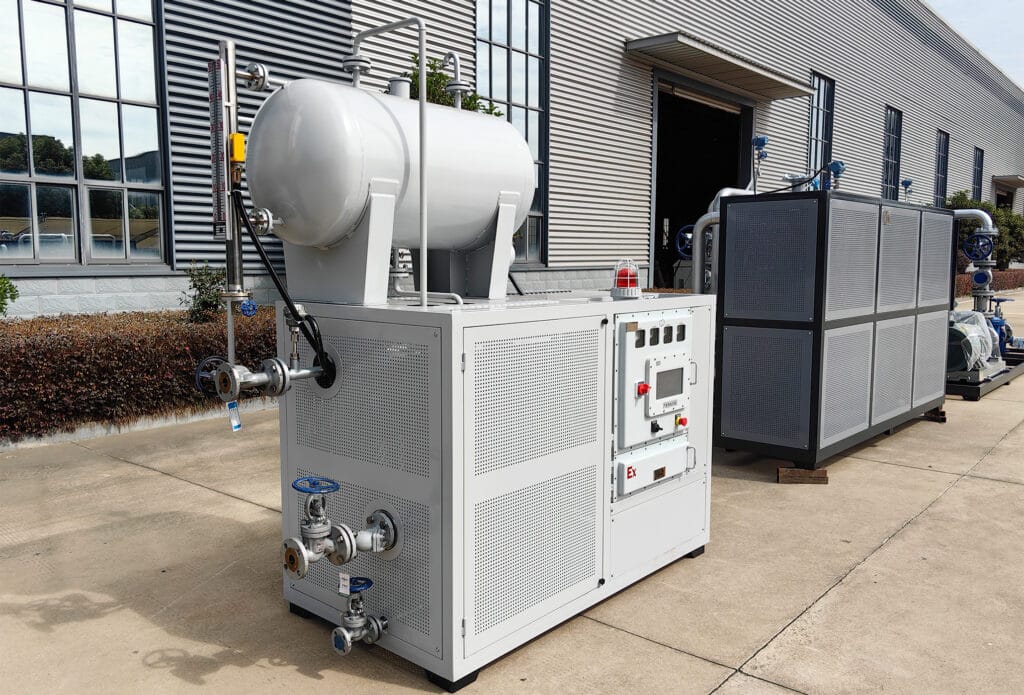
A thermal oil heater uses organic heat transfer oil as the medium. The system drives the thermal oil in a forced circulation loop. A hot oil pump keeps the flow moving. The oil heats users continuously through the loop.
A steam boiler heats water to generate steam. Then steam flows to heat users. Condensate returns and the cycle repeats.
So the main difference looks simple: thermal oil vs water/steam. But this choice affects pressure, controls, and maintenance.
2) Temperature control: precision vs process variation
When people ask to compare thermal oil heater and steam boiler, temperature control usually comes first.
For a thermal oil heater system in the provided data, temperature control accuracy can reach ±1°C. That level of control fits processes that dislike swings.
Steam systems often face more variables across the network. Steam quality, condensate handling, and distribution losses can influence end-point stability. Even if the boiler control works well, the plant still needs to manage the entire steam loop.
Therefore, if your process values tight and direct temperature control, a thermal oil heater often feels more straightforward at the user side.
3) System complexity: compact loop vs larger steam ecosystem
A thermal oil heater typically runs as a closed-loop heating circuit. It still needs key components, such as the heater body, hot oil pump, and expansion tank. However, the overall “heat delivery logic” stays direct: heat oil, pump oil, deliver heat.
A steam boiler system usually grows into a wider ecosystem. You manage steam distribution, condensate recovery, and many valves and traps. In real plants, that adds more places where performance can drift.
So, from a system complexity angle, many teams find the thermal oil heater easier to scale around a single loop, while the steam boiler needs stronger system-level discipline.
4) Initial investment: depends on scope, not only the boiler price
Initial investment does not equal equipment price. It includes the system you must build around the heat source.
A thermal oil heater often supports a modular equipment approach. In the given product range, electric thermal oil heater models cover multiple heating powers (for example, 10–300 kW in the described product line, and additional models listed beyond that). That makes it easier to match capacity to a production cell and expand later.
A steam boiler project can require more site-wide infrastructure. Once you include steam piping, condensate return, and related auxiliaries, the scope can expand.
So when you compare thermal oil heater and steam boiler on investment, compare total installed system cost and future expansion cost, not only the nameplate unit.
5) Operating pressure: pressure class changes the whole risk profile
Operating pressure impacts design rules, inspection routines, and how operators “feel” about the system.
The provided materials highlight compliance around boiler safety supervision rules (TSG G0001-2012). That signals the seriousness of regulated boiler systems and the need to align design, manufacture, and installation with supervision requirements.
For many users, a thermal oil heater can deliver high-temperature heat transfer through circulating oil, which reduces the need to rely on a steam distribution pressure network for heat delivery. In contrast, a steam boiler inherently deals with steam generation and management.
In practice, pressure management often drives training needs, inspection planning, and safety documentation.
6) Heat efficiency: look for tested numbers, not assumptions
Heat efficiency often becomes a marketing battlefield. Here we stick to stated figures.
In the provided product description for the electric organic thermal carrier boiler (thermal oil heater / thermal oil furnace), the system can reach heat efficiency above 95%.
When you compare thermal oil heater and steam boiler, use verified data from your selected model and your operating conditions. Also consider distribution losses. Even with a strong boiler efficiency, a complex steam network may lose more heat along the way.
7) Maintenance requirements: where do failures usually hide?
Maintenance workload depends on component count and the harshness of the operating environment.
A thermal oil heater system focuses attention on the circulation loop and its core equipment. In the provided data tables, the system uses hot oil pumps and includes expansion tank parameters. That means your preventive maintenance often centers on pump condition and system integrity.
A steam boiler system spreads maintenance points across the site. Steam traps, condensate lines, and control valves can introduce frequent checks. Moreover, steam distribution issues often show up as “process problems,” not as obvious boiler alarms.
So maintenance planning often looks more centralized with a thermal oil heater, and more network-based with a steam boiler.
8) Safety regulations: compliance is part of the engineering
Safety never stays optional. It becomes paperwork, inspection, and engineering discipline.
The provided content mentions alignment with TSG G0001-2012 “Boiler Safety Technical Supervision Regulation,” plus special inspection supervision. It also lists certifications and capabilities such as CE and specific manufacturing licenses for boiler and pressure vessels.
For the thermal oil heater products described, the system can offer explosion-proof rating Exd II CT4 and protection level IP66. Those details matter when you run heating equipment near solvents, dust, or harsh plant conditions.
So do not treat “thermal oil heater vs steam boiler” as only a performance question. Treat it as a compliance pathway question too, including certification, inspection, and documentation.
9) Typical applications: match the heat style to the industry
Different industries ask for different heat “behaviors.”
The provided materials show the supplier serves petrochemical, chemical fiber, chemical engineering, and non-standard equipment projects. It also mentions polymer-industry supporting equipment, such as vacuum cleaning furnaces used for cleaning spinnerets, screws, and filter meshes, with features like automatic control and multiple safety protections.
These application hints matter. Processes in polymer and chemical fiber lines often value continuous heat delivery and stable temperature control. That aligns naturally with a thermal oil heater circulation approach.
Steam boiler systems often fit plants that already rely on steam widely, or that use steam as both heat and a utility across many workshops. In that case, the steam boiler integrates into an existing steam culture.
Quick decision checklist (use before you lock the design)
If you still need a clean way to decide, use this checklist:
✔️Choose a thermal oil heater when you want tighter temperature control (the provided system states ±1°C) and a direct circulation loop.
✔️Choose a steam boiler when you need steam as a plant-wide utility and you can manage the full steam system discipline.
✔️Validate heat efficiency with stated numbers (the thermal oil heater line states >95%).
✔️Review compliance early. Use the right supervision and certification path.
✔️Compare total system cost, not only the heat source equipment.
In the end, engineers do not “buy heat.” They buy stability, controllability, and risk reduction.