
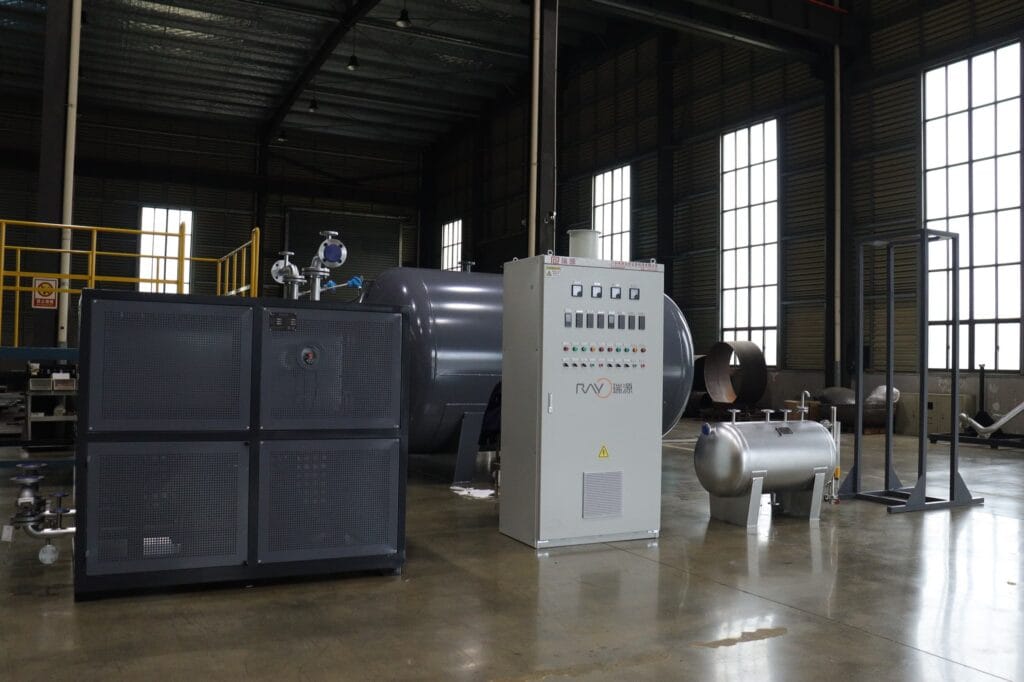
Many people new to temperature control equipment often mistake **thermal oil heaters** for water temperature controllers. They assume both devices simply maintain a set temperature. However, once you move to the actual production floor, the differences become clear. Maximum temperature, system pressure behavior, heat transfer fluid properties, and suitable processes all directly impact stability and safety margins.
This article breaks down the differences between thermal oil heaters and water temperature controllers across four key areas. By the end, you will know exactly which system fits your operating conditions.
1. Operating Temperature Range: Defining the Upper Limit and Process Flexibility
Thermal oil heaters use organic heat transfer fluids (thermal oil) as the medium. This design allows processes to continuously access the required thermal energy. These systems work best for applications that demand higher temperatures and minimal temperature fluctuation.
Water temperature controllers use water as the medium. Water has high specific heat and excellent heat transfer efficiency. For low- to medium-temperature control, water systems respond quickly and cost less. However, as process temperatures rise, phase changes in water introduce significant system constraints. This limitation explains why many high-temperature processes eventually switch to oil-based systems.
If your process requires a high upper temperature limit and long-term, stable heat supply, thermal oil heaters typically offer greater flexibility. For routine low- to medium-temperature control with fast heat exchange and simple configuration, water temperature controllers are the more common choice.
2. System Pressure Differences: Distinct Pressure Characteristics, Not Just “Higher or Lower”
In a thermal oil system, the circulation pump forces the medium through a closed loop. This means the system prioritizes stable flow and consistent circulation. Pressure levels mainly depend on engineering factors such as circulation resistance, pipe length, and heat exchanger design.
Water systems present a different pressure profile. Pressure issues often couple closely with temperature and phase state. As temperature increases, requirements for system sealing and pressure control become stricter. Many facilities hesitate to use water systems at elevated temperatures precisely because they must carefully balance pressure control complexity against safety margins.
To summarize: thermal oil heaters focus on circulation stability and managing pipe resistance. Water systems focus on pressure control and boundary management as temperatures rise. Do not reduce this comparison to a simple “which pressure is higher” question.
3. Heat Transfer Fluid Properties: Two Different Operating Logics
Thermal oil, as an organic heat transfer fluid, offers a clear advantage: it delivers continuous, stable heat to users under forced circulation. Thermal oil heaters achieve temperature control accuracy of ±1°C and thermal efficiency above 95%. These performance metrics directly reflect the controllability of oil as a medium in circulating heat supply.
Water excels in rapid heat transfer and easy availability. It also requires less specialized knowledge to operate. However, water becomes more sensitive to operating boundaries, especially as temperature rises above its natural limits. Because of these different fluid properties, thermal oil heaters function more like continuous heat supply systems, while water temperature controllers behave like responsive, high-efficiency temperature regulation units.
Additionally, thermal oil heaters can integrate optional features such as RS485 communication, remote automation, data acquisition, explosion-proof ratings up to Exd II CT4, and IP66 protection. These configurations suit continuous operation and complex site management. Water systems can also support automation, but you must first determine whether your process truly needs that level of redundancy and protection.
4. Typical Applications: Process Needs, Not Industry Labels, Determine the Choice
Thermal oil heaters often serve thermal users (heat-using equipment or circulating loops) that require continuous energy delivery. Industries such as chemical engineering, petrochemicals, and fibers commonly rely on them. These sectors share common traits: long process cycles, continuous operation, high sensitivity to temperature stability, and a need for uninterrupted heat supply. Under these conditions, the advantages of thermal oil heaters become most apparent.
Water temperature controllers appear more often in low- to medium-temperature applications with rapid heat exchange and a preference for system simplicity. In many cases, the process simply does not require the higher temperatures and continuous heat supply that justify a more complex oil system.
Use this simple rule of thumb:
– Choose thermal oil heaters for higher temperatures, longer continuous heating periods, and more stable thermal output.
– Choose water temperature controllers for medium- to low-temperature control, rapid heat exchange, and lighter system weight.
Final Selection Advice: Start with Your Process, Then Evaluate Equipment
Do not begin with price comparisons or simply follow what others use. Instead, write down answers to four questions:
1. What target temperature range does your process require?
2. Do you need continuous heating or frequent temperature cycling?
3. Does your system prioritize circulation stability or pressure boundary management?
4. Does your heat-using equipment continuously draw thermal energy, or does it cycle through temperature stages?
Once you answer these questions, the right choice becomes clear.
If you share your industry, target temperature range, and type of heat-using equipment, we can further refine your selection. We will follow the same four criteria—temperature range, pressure characteristics, medium properties, and application scenario—to deliver a specific configuration recommendation.